
Finding Oakland Residents by Record
Oakland does not keep one public list of every household. Start with the record tied to the question. An address points first to the parcel and its ten-digit PIN. A recorded owner or a past transfer points to the Register of Deeds. A person named in a public case may be found through a court index, while an older household may appear in a directory or newspaper. Because Oakland has 62 cities, villages, and townships, identify the municipality before asking for a permit, cemetery file, code record, or local clerk register. Those local files are not gathered into one countywide people index.
The Oakland residents directory is strongest when each result is dated. A mailing address is not necessarily the physical parcel address. A deed party is not automatically a current occupant. A historic directory entry is a snapshot from its publication year. That discipline makes the trail useful for family history, estate questions, reconnecting, or checking a property-related claim without overstating what a record proves.
- Enter the known Oakland address in Property Gateway and save the PIN, situs address, and municipality.
- Use the PIN, legal description, or party name in the recorded-document index when a title trail is needed.
- For one person, compare the record date and role with public court, business, license, or lawful voter-record channels.
- For an older Oakland household, match a directory year with a census, obituary, newspaper, deed, or tax-roll lead.
- When the web route ends, contact the named custodian, library, historical society, archives, or use a focused FOIA request for an existing nonexempt county record.
Oakland Resident Records Offices
The Oakland County Clerk/Register of Deeds brings several trails together in Pontiac. Its land-record division maintains the Super Index. Its Legal Records Division handles Sixth Judicial Circuit files, and its Vital Records Division supplies county event records subject to eligibility rules. Property Gateway is the county parcel and mapping route, although municipal communities supply the assessment data. The Michigan voter service is for a voter’s own information, while a wider Qualified Voter File request follows the state FOIA process. Street-by-street parcel work belongs on the Oakland street directory page.
Oakland County Register of Deeds
1200 North Telegraph Road, Department 480
Pontiac, MI 48341
248-858-0597
Oakland Property Gateway
County parcel and mapping service
Municipal assessment data
248-858-8812
Michigan elections service
State voter information and clerk locator
Local clerk handles corrections
Statewide online service
Note: Court files are not obtained through the Oakland County FOIA route, so ask the court custodian for dockets, copies, and certification.
Oakland PIN-First Property Search
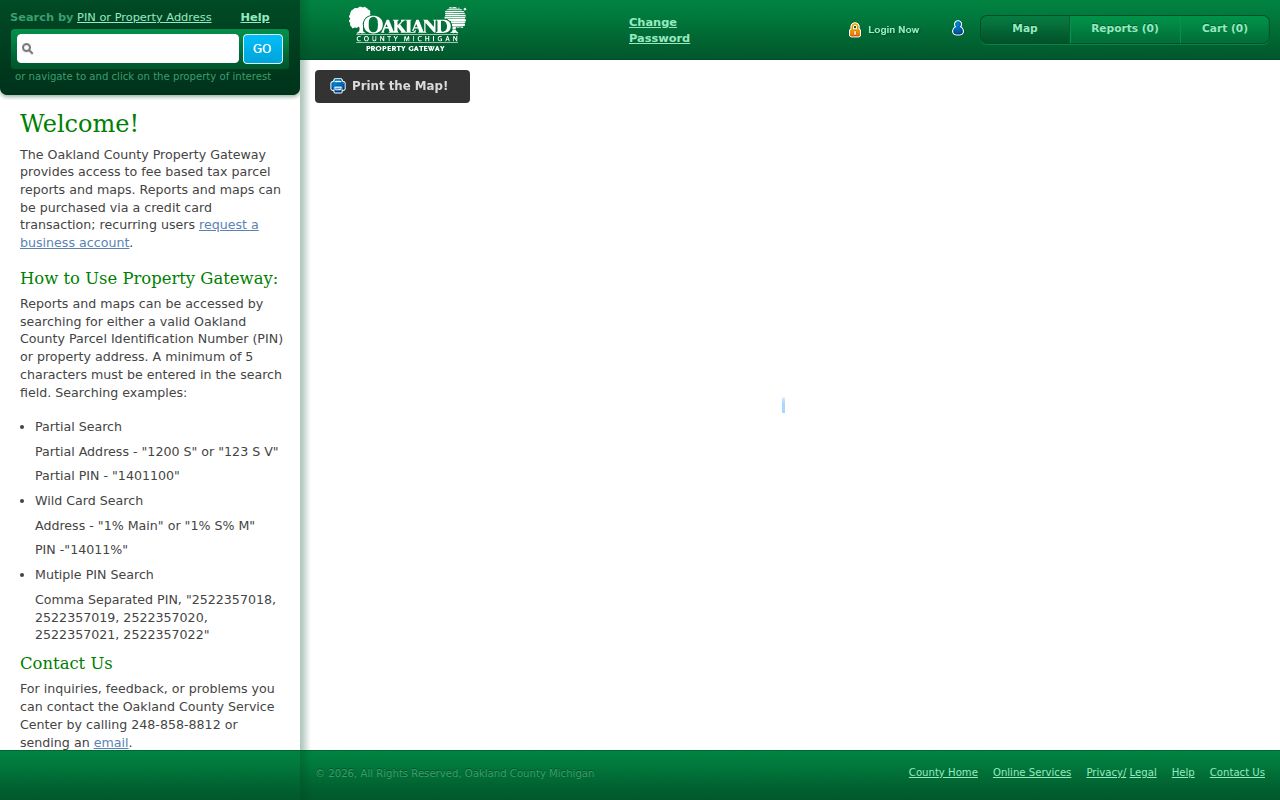
Property Gateway is a practical entry point when the Oakland address is known. It accepts a property address or PIN, not a general owner-name search as its primary public mode. The Gateway accepts at least five characters, partial addresses, percent-sign wildcards, partial PINs, and comma-separated multiple PINs. A map click can also open a parcel. The selected parcel identifies its municipality, which matters because the underlying assessment data and available products differ among Oakland communities. The separate tax search has different rules: it accepts an address with municipality and tax details or a parcel route without dashes or spaces.
| Property Gateway field | How Oakland uses it |
|---|---|
| Property address | At least five characters; partial and wildcard forms are supported. |
| PIN | Ten-digit parcel identifier; dashes are optional, and partial or multiple PIN searches are supported. |
| Map click | Opens the parcel selected on the county map. |
| Product or report | Preview, cart, checkout, and availability vary by municipality. |
The Oakland Property Gateway search is shown below. Its address and PIN controls lead to a parcel, not a promise that every person connected to the parcel lives there.
Keep the PIN, situs address, legal description, municipality, and date of the search together before moving to an Oakland deed or tax record.
Oakland Super Index After 1964
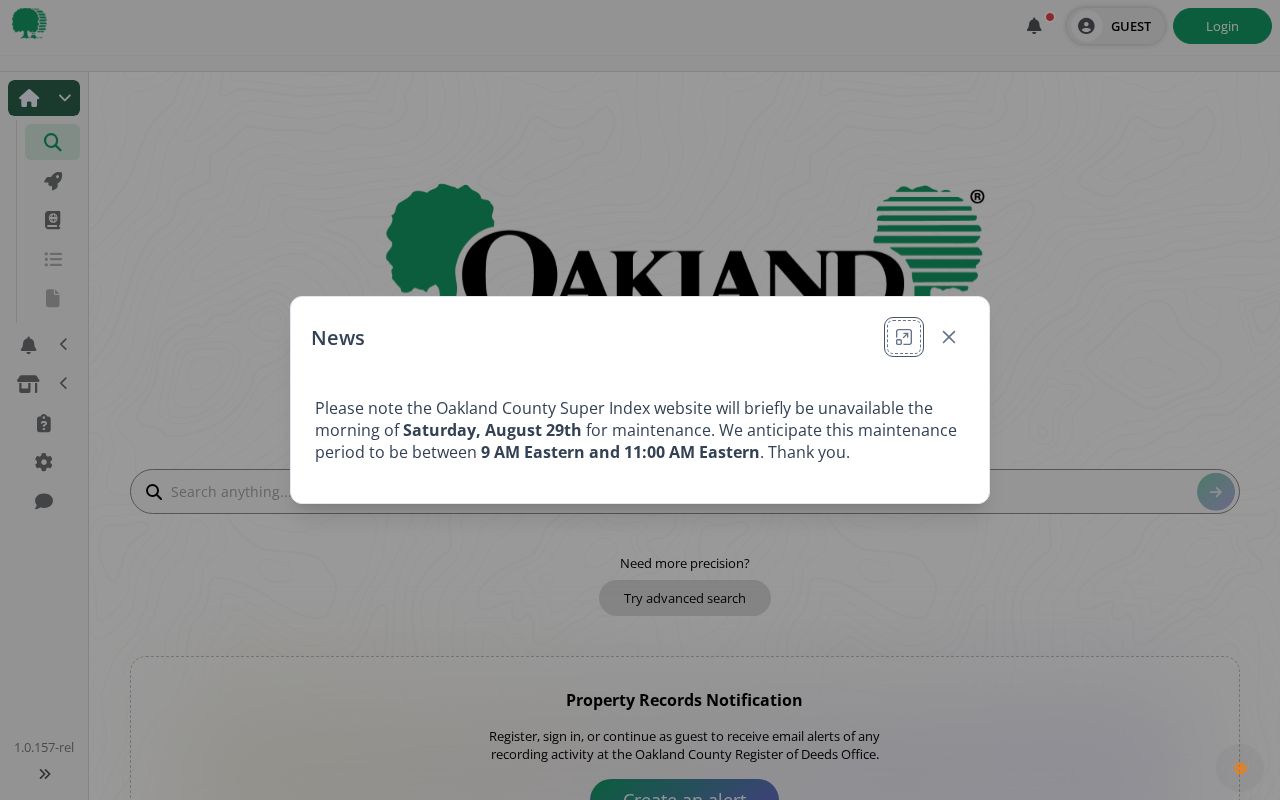
The Super Index is Oakland’s recorded-land entry point. County materials say its online document collection reaches January 1, 1964, while land records themselves reach into the early 1800s. Indexed searching and sorting by information such as name or ten-digit PIN are free; printing or downloading documents costs money. Search by party, grantor or grantee role, PIN, document number, document type, recording or processed date, record year, and available subdivision or text criteria. Older transfers require the Register of Deeds, historical tract indexes, books, microfilm, the Archives of Michigan, or a local historical repository.
The Oakland Super Index page is the source of the land-record search shown here. It is useful for tying a name to an instrument, but a deed result needs its legal description and recording details read in context.
For a backward trail, search a seller as the prior grantee and retain the instrument type, recording date, document number, and party role at every step.
Oakland Current Resident Rolls
Current sources answer different questions. Parcel material can show a recorded owner or tax-mailing address. The deed index records parties to a filing. Public court and probate indexes show case involvement when the case is available. A voter record is public under Michigan law but has an important confidential split, and Michigan.gov/Vote is an individualized service rather than a street browser. The Oakland residents directory should therefore treat each source as evidence of a particular connection and date, not as a master list.
| Oakland source | Connection it can show | Keeper | Access route |
|---|---|---|---|
| Property Gateway | Parcel, situs, tax and available local parcel details | County and local assessors | Address or PIN map search; products vary |
| Super Index | Recorded-document parties and land trail | Register of Deeds | Free index; copies paid |
| Qualified Voter File | Releasable registration fields and voter history if requested | Michigan Bureau of Elections | FOIA request with geographic scope |
| Court Explorer | Public circuit or probate case activity | Oakland courts | Online index; copies through custodian |
| License and entity records | Official professional or business affiliation | Michigan LARA | State search portals |
A name that appears in one Oakland record can belong to a former owner, an agent, a case party, or a license holder. The Oakland resident lookup follows the one-person verification path instead of treating those roles as interchangeable.
Oakland Voter Records Have Limits
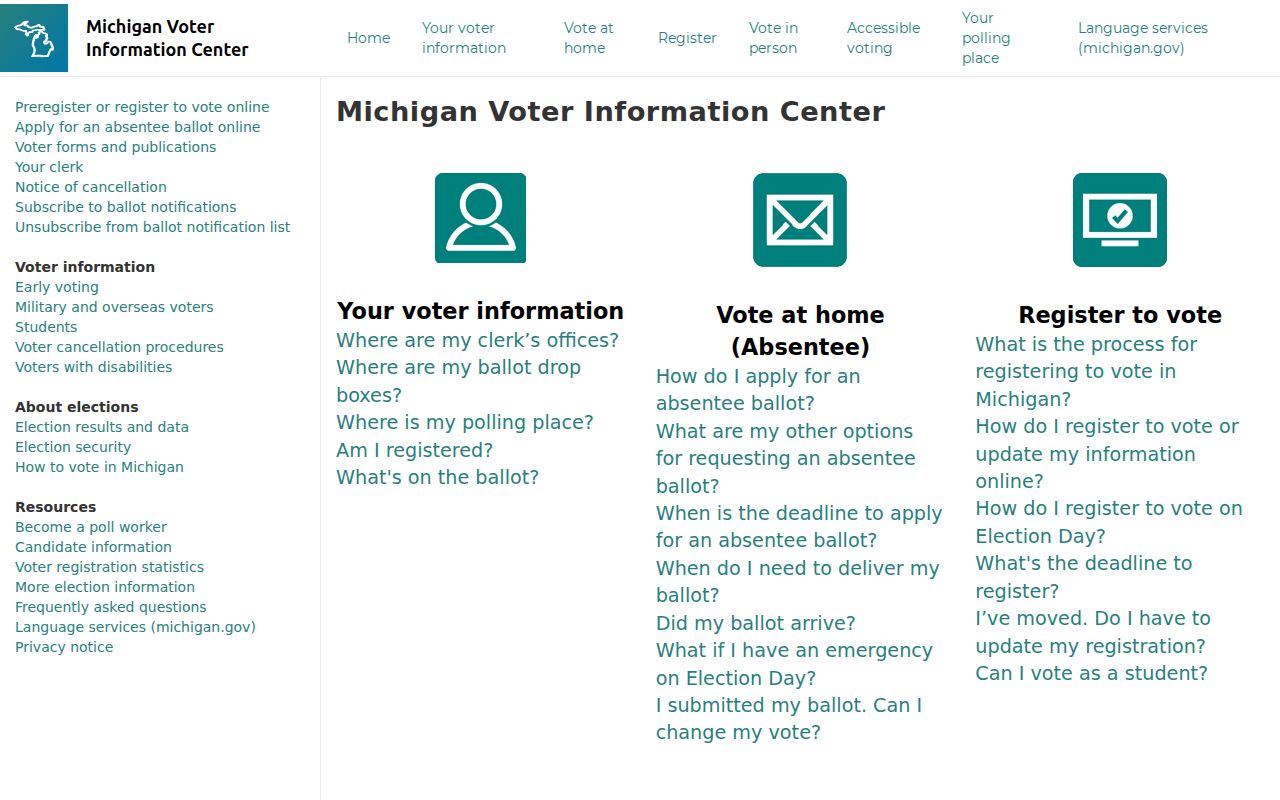
Michigan.gov/Vote helps a voter check their own registration status, clerk, ballot, polling information, and address-update path. For a county, jurisdiction, ward, or precinct request, the Michigan Qualified Voter File form offers a defined FOIA route. It allows one geographic selection and delivery by pickup, FTP, or mail rather than ordinary email. Michigan FOIA does not turn the individual lookup into an open browse-by-street tool. A request can include voter history, while a personalized lookup should never be used to infer that a nonmatch lacks any Oakland connection.
- Public registration record
- Michigan law treats registration records as public documents, subject to specific redactions.
- Protected fields
- Driver-license or ID numbers, month and day of birth, phone, email, signature, last four Social Security digits, and Address Confidentiality Program information are withheld.
- Voter history
- It can show participation when lawfully released, not how a voter voted.
The Michigan Voter Information Center provides the individualized Oakland voter route pictured here. A nonmatch should be checked with the proper local clerk.
Michigan’s Address Confidentiality Program supplies substitute-address and protected-registration handling for eligible people facing threats or violence.
Oakland Courts Confirm a Role
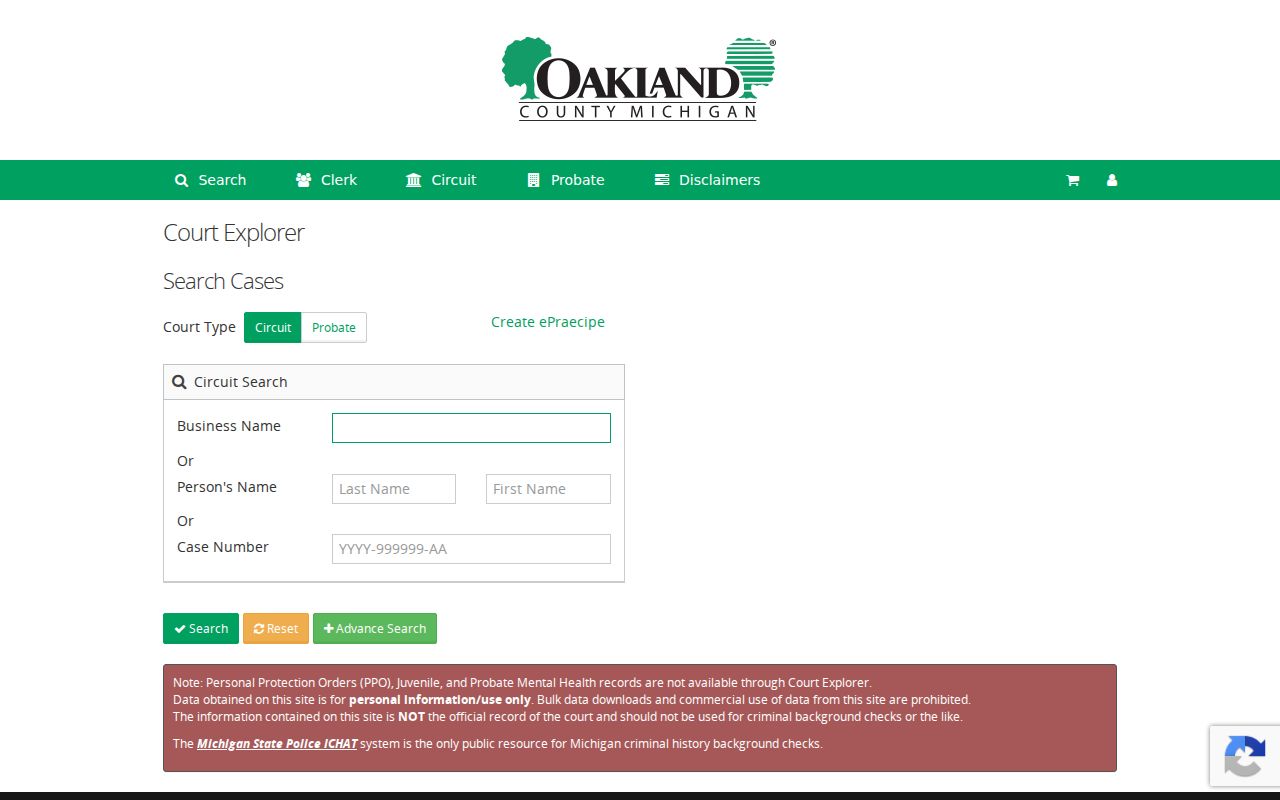
Court Explorer covers available Sixth Judicial Circuit public records, including civil, domestic, business, appeals, and felony matters. The county describes online public records from the early 1990s forward. Probate has a free name-search path to locate a case number; copies then follow the court workflow. Oakland district matters are not all held in a single municipal court, so the filing city and district jurisdiction determine whether MiCOURT or a named district clerk is the next route. Federal matters use PACER rather than the county system.
The Oakland Court Explorer interface below separates Circuit and Probate routes. Its public result is informational; excluded categories, sealed material, and the actual court file remain subject to the court’s rules.
Regular copies are listed at $1 per page, while certified court copies have a case-number charge plus page fees. Older files can be requested from the clerk in person or by mail.
Oakland Vital and Genealogy Paths
For an Oakland event, the county genealogy service offers a free marriage and death index search. County research reaches marriage records back to 1827 and death records back to 1867, while the online search begins at 1868 for marriages and 1900 for deaths. A certificate copy has a fee. Birth records are different: Michigan restricts births under 100 years under MCL 333.2882, and the Oakland county application limits access to eligible requesters with identity requirements. Statewide MDHHS records, registered from 1867, provide online, telephone, mail, drop-box, appointment, and will-call channels.
The Oakland County birth application illustrates the county’s identity-and-eligibility route. It is not a public name-search directory.
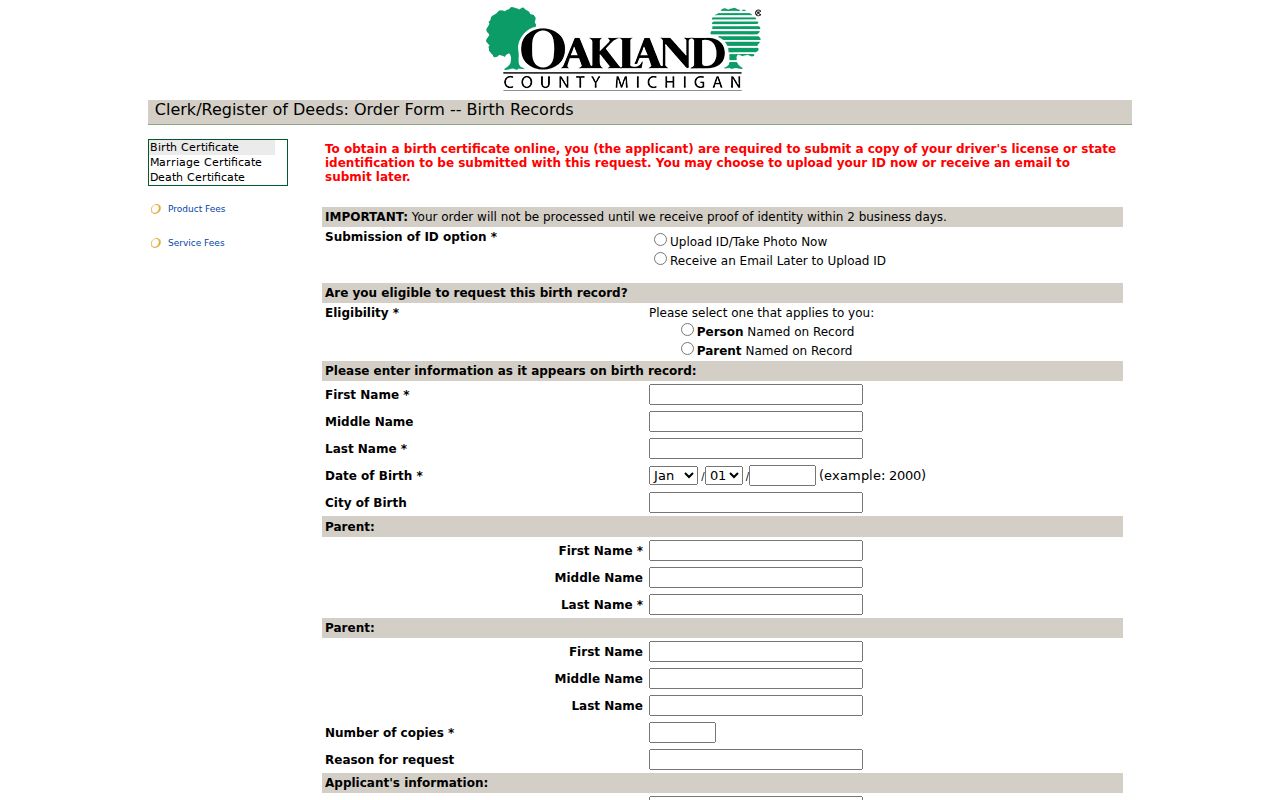
Use a marriage or death index as an identity anchor, then request a copy only through the keeper and eligibility channel that applies.
The Michigan vital-record ordering page shows the statewide request route and its delivery choices.
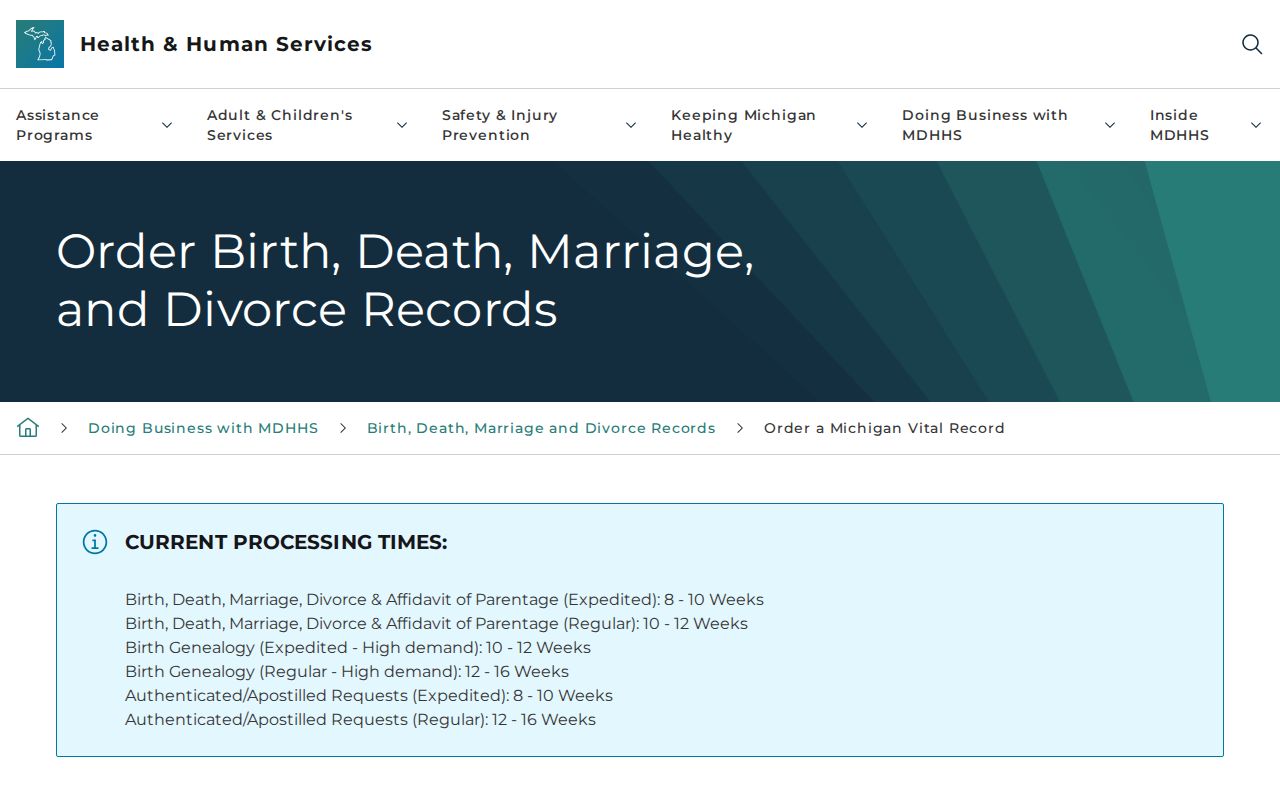
State processing, identity, and eligibility requirements should be confirmed with MDHHS before sending an Oakland-related request.
Oakland Historical Resident Directories
The historical Oakland residents directory shelf is unusually strong but uneven by place and year. The Oakland County Historical Society holds the 1860–61 Pontiac–Flint directory, an 1886 Pontiac and Oakland County directory, Pontiac volumes from 1895 through 1915, later Polk editions, a 1930 Arrow Street Guide, and a 1931 Pontiac telephone directory. Its shelf list also identifies Royal Oak, Birmingham, North Oakland, and South Oakland runs. A Bresser criss-cross directory starts from a street and house number, then lists an occupant or business, phone, and possible owner-renter notation.
The Oakland County Historical Society shelf list is the starting point for those cataloged runs. The full collection and entry-reading method are on the Oakland directory book page.
- Parcel
- A defined piece of land tracked by a PIN and legal description.
- Index
- A finder tool that points to a record; it is not always the record image itself.
- Criss-cross directory
- An address-first directory that can connect a street number to a listed occupant or business.
- Roll
- A dated record set, such as a tax roll or registration list, maintained for a particular purpose.
Oakland Newspaper and License Leads
When an Oakland name disappears between directories, the newspaper and license layers can add a dated lead. Pontiac Public Library offers microfilm research from 1835 through 2019 for a specified date window, with a $3 staff-search fee. Its online resources include Pontiac History and Oakland Press searching from 2004 onward. The Library of Michigan’s Oakland guide adds historical newspapers, an 1845 state census, naturalization records, probate abstracts, maps, and an obituary index. These are research paths, not proof of present residence.
For a professional connection, the Michigan LARA license search is shown below. It reports official credential information such as name, profession, status, dates, and permitted address fields.
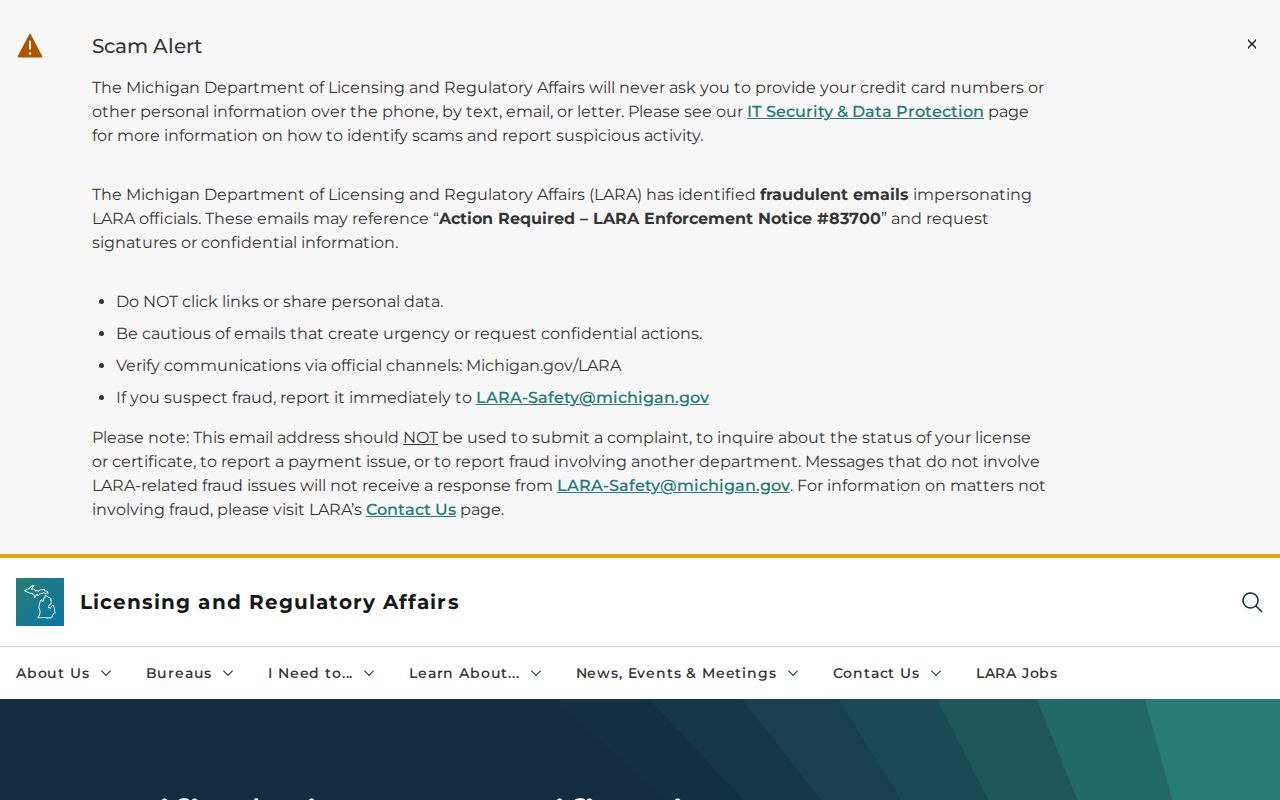
Separate an official professional affiliation from a personal residence, and preserve the record’s status date with the result.
Oakland FOIA and Offline Fallbacks
Michigan FOIA, 1976 PA 442, MCL 15.231–15.246, lets any person request existing public records from a public body. The usual response period is five business days after legal receipt, with a written ten-business-day extension possible. Search, review, separation of exempt material, copying, and mailing can be charged within the law. A request cannot require the office to create a new record. Oakland County’s FOIA center is useful for a specific existing county record that is not already directly available.
For an older Oakland deed, start with the Register of Deeds rather than assuming the web index is complete. For a local permit, cemetery item, or code file, approach the city, village, or township custodian. For directories, maps, newspapers, and transferred material, use the historical society, local library, Oakland County Genealogical Society, Library of Michigan, or Archives of Michigan. Court records follow the court custodian, not county FOIA.
Note: A precise record request names the series, date range, address or parcel, and desired copy rather than asking an office to search every possible Oakland file.
Oakland Resident Search Boundaries
Oakland’s many databases have real edges. Driver and vehicle personal information is not a general lookup source. Renters, utility subscribers, non-owner household members, sealed court material, juvenile records, protected voter fields, and Address Confidentiality Program participants do not become public merely because an address is known. A map boundary is not a legal survey, and a ZIP, precinct, or municipal district may cover different geography. Treat a portal result as a starting point, then verify important details with the office that holds the record.
Lawful personal research. Use Oakland public records for legitimate personal, family-history, estate, property, and civic questions. Never use a record to stalk, harass, intimidate, or harm another person.
Oakland’s 62 local governments are the practical reason a county name alone can be too broad. A Pontiac parcel, Troy permit, and Royal Oak directory entry can require different custodians even when each is part of the same county story.