
Oakland County Resident Lookup Records
Official sources in Oakland County do not produce one all-purpose name result. Each record proves a different connection. Property Gateway is parcel-first, while the Super Index records parties to land documents. Michigan Voter Information Center is an individualized voter service, not a public name-and-address browser. Court, vital, business, and license records add useful checks, but each has its own access boundary. A resident lookup works best when a known name, municipality, and date are held against the record that actually answers the question.
| Official record | Connection it can confirm | Oakland route | Access boundary |
|---|---|---|---|
| Parcel or tax record | Recorded owner, situs, or tax-mailing connection | Property Gateway and local assessment data | Municipal product availability varies; mailing address is not occupancy proof. |
| Recorded land document | Grantor, grantee, lien, trustee, or estate role | Super Index, online from 1964 | Index searches are free; document copies cost money; earlier material needs an office or archive route. |
| Public court file | Party role, case activity, or probate status | Court Explorer and the Probate route | Excluded and nonpublic categories stay unavailable; copies have fees. |
| Marriage or death index | Event, spouse, or death-date identity anchor | Oakland genealogy service | Online county searching is free; a certificate is a separate order. |
| Business or credential file | Official affiliation or license status | Michigan entity search and MiPLUS/MiCLEAR | Shows a filed association, not a residence claim. |
Begin with the least ambiguous combination, normally a full name plus municipality and a known address or approximate year. A parcel’s situs is the physical location. Its mailing address is simply where tax notices go. A land-document party, voter registrant, business officer, and license holder with the same name may be different people. Keep the source, date, record number, address type, and role together rather than combining details from separate results.
Oakland Resident Court Fields
Oakland County Court Explorer searches Sixth Judicial Circuit and Probate paths. The Circuit form permits a business name, last and first name, case number, party type, case-year range, and case-type range. Probate document searching in Court Explorer is case-number based. The separate Oakland Probate online service can supply the case number first. Use the register of actions to see dated events, then ask the clerk about the actual file or a certified copy when the record is releasable.
The Court Explorer search screen is shown here. The display is an informational index. It does not include PPO, juvenile, or probate mental-health material, and it is not the official court record. A public web result is a lead, not a complete finding.
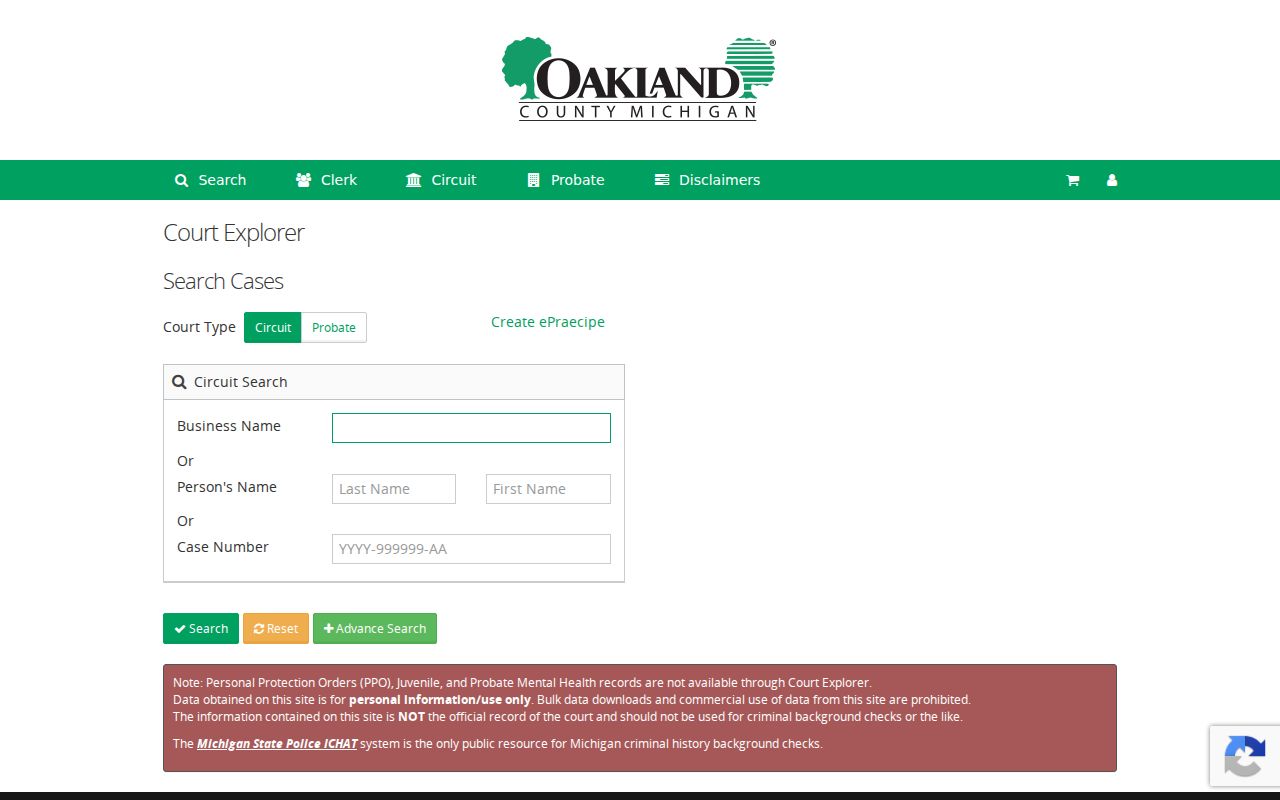
A result can show a case number, title, division, judge, party role, dated events, and document links where available. Test a surname with and without a middle initial, record all possible case numbers, and use the named court clerk to identify an older, archived, restricted, or certified-copy route. For district-court matters, MiCOURT Case Search and the responsible district clerk are the correct follow-up channels because district jurisdiction follows the filing community.
| Court Explorer input | Use in a name verification |
|---|---|
| Court type | Choose the Circuit or Probate route. |
| Person name | Try the indexed first and last name, then document spelling variants. |
| Case number | Use the displayed YYYY-999999-AA form where it is known. |
| Year and case type | Narrow a broad same-name result by a relevant filing period or code. |
Oakland Resident Name Matches
A same-name hit is only a candidate. Compare the exact indexed name, middle initial or suffix, municipality, record role, date, parcel PIN, spouse or parent name, and street when those fields are lawfully visible. Do not copy a birth year from one database into another as though it proves identity. When two official sources conflict, retain both observations and ask the named custodian which field controls that record series.
For a current property question, compare a document party with the parcel’s PIN and legal description. For a historical question, state the period plainly: an owner in a tax record, a party in a case, and a person listed in an old directory are different claims. The Oakland Directory Book is the better internal route for understanding dated directory entries and criss-cross volumes; it should not be used to turn a historic listing into a current address assertion.
Note: A nonmatch in an interactive index means the index did not locate that search, not that the person has no Oakland County connection.
Verify an Oakland County Resident
Use one verification chain and write down each result before adding another. Start with a known address or parcel rather than a loose surname. The sequence below keeps property, court, and vital evidence in their proper roles. It also provides a clean stopping point when a record is restricted or its date falls outside an online index.
- Search Property Gateway by a property address or ten-digit PIN, then record the PIN, situs, municipality, and view date. Do not treat the tax mailing address as evidence of who lives there.
- Search the Super Index for a relevant party name, PIN, document number, or date. Read the grantor or grantee role and legal description before treating a document as a property connection.
- Use Court Explorer or the Probate name route only to test the matching name, date, role, and case number. Request a regular or certified copy from the court custodian when that is the needed evidence.
- Use the county marriage and death genealogy index as a dated identity anchor. If a birth record is involved, stop at the eligibility rule rather than attempting to infer protected details.
- Docket
- A docket, also called a register of actions, is the court’s dated list of filings and events in a case.
- Index and image
- An index helps locate a record. The document image or paper file is the underlying record and may require a paid copy or counter request.
- Certified copy
- A certified copy is issued by the custodian with its official certification for uses that require it; an ordinary screen result is not the same thing.
Older Sixth Circuit files are requested in person or by mail through the clerk, not assumed missing because Court Explorer begins in the early 1990s. The county lists regular copies at $1 per page and certified copies at $10 per case number plus $1 per page. Court Explorer copy orders can be mailed or emailed, while certified documents must be mailed. Probate copies follow the Probate Court’s case-number workflow and fee rules.
Oakland Genealogy Identity Anchors
The Oakland County genealogy service gives a useful free index route for marriage and death research. Online marriage searching can reach 1868 and death searching can reach 1900. In-person historical research reaches marriage records back to 1827 and death records back to 1867. A search hit can connect a name to an event or spouse, but a certificate is ordered separately and must be read in light of the record’s date and access rule.
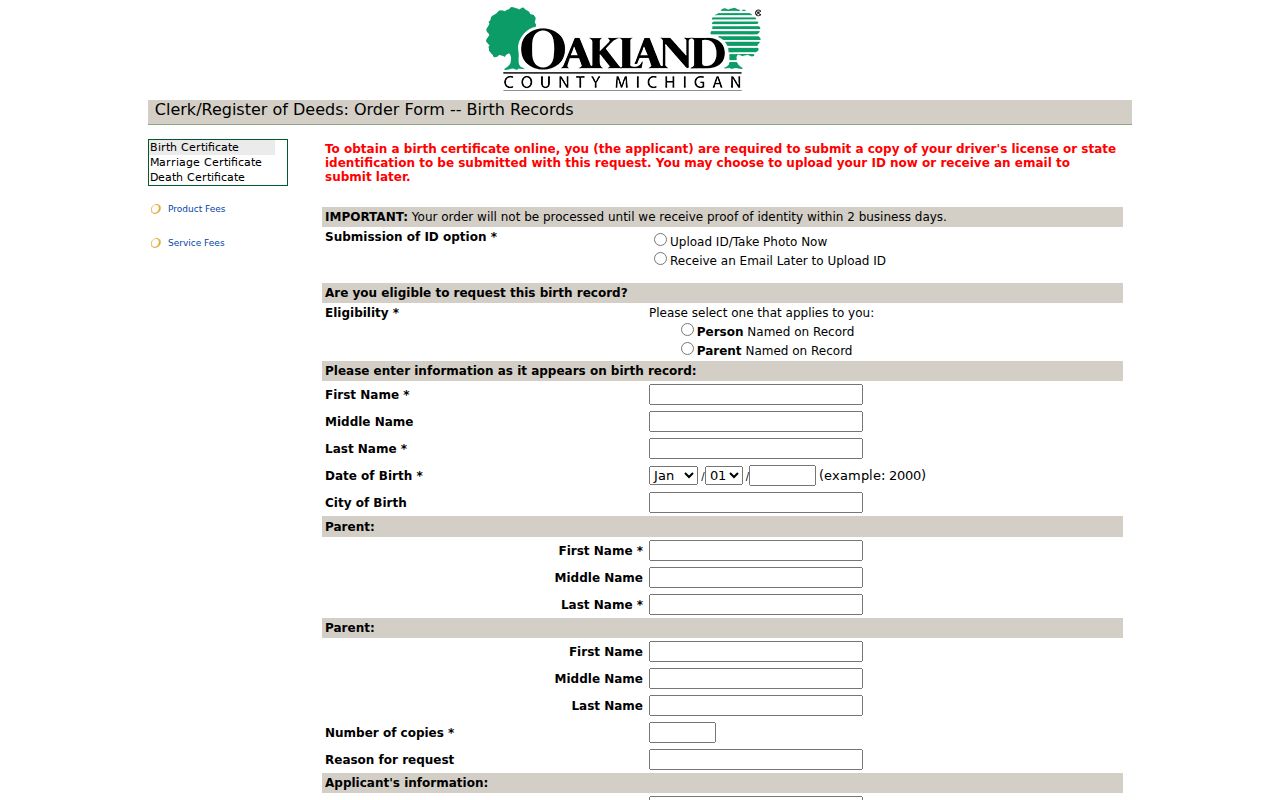
The Oakland County birth application makes the difference clear. The county form asks for identification, an eligible relationship, the subject and parent information, applicant information, and a typed certification. It is not a public name-search tool. Michigan restricts a birth record less than 100 years old under MCL 333.2882 to the subject, named parent, guardian, authorized representative, eligible heir, or a court order. A record over 100 years is generally open, subject to other restrictions.
The county birth application is an eligibility-and-order screen, not a resident index. That distinction protects a person’s birth information while preserving a lawful route for people who qualify.
For statewide events, Michigan MDHHS Vital Records holds registered records from 1867 and offers online, mail, phone, drop-box, Will Call, and appointment channels. County mail requests require the completed form, identification copy, payment, and stamped self-addressed envelope. A searchable death or marriage index is not the same as a certified record, and no result does not prove that an event never occurred.
Oakland Probate Connects Heirs
For an estate or heir question, begin with the decedent or estate name in the Oakland Probate search route. Once a case number is found, Court Explorer can be used for the public case trail. Relevant dated events may include a petition, notice, letters of authority, inventory, change of address, proof of service, closing statement, and certificate of completion. Each event is evidence inside the case, not a statement that an interested party currently lives at any listed address.
This is a useful human trail for a family member handling an estate, but its limits matter. Ask Probate for copies, not the county FOIA system. If real property moved through the estate, compare the recorded transfer in Super Index with the probate timeline. A deed chain follows title; it does not identify every household member. That division prevents the search process from overstating what an estate file proves.
Oakland Resident Lookup Fallbacks
When an official web trail stops, switch to the custodian that holds the next series. Ask the Oakland County Register of Deeds about older grantor-grantee books, tract indexes, deed volumes, or microfilm before treating the 1964 online cutoff as a record loss. Ask the local city, village, or township clerk for a narrow permit, cemetery, or local register request, because Oakland County has 62 local communities and many records stay with that municipality. Libraries, the Oakland County Historical Society, the Oakland County Genealogical Society, and the Archives of Michigan county guide can help locate historical directories, newspapers, maps, and transferred county material.
Oakland County’s FOIA Request Center is the route for a specific existing county record that is not otherwise directly available and is not exempt. Michigan FOIA is 1976 PA 442, MCL 15.231–15.246. The public body has five business days after legal receipt to respond and may issue a written ten-business-day extension. Search, review, redaction, copying, and mailing costs can apply. Court records are outside the county FOIA route, so use the court clerk instead.
Oakland Resident Lookup Limits
Some records are deliberately not general resident-search material. Michigan voter files are public documents under FOIA, but MCL 168.509gg withholds protected fields and Address Confidentiality Program records. Michigan.gov/Vote is intended for a voter’s own information, while a QVF request follows a separate, redacted public-record process. Juvenile, adoption, sealed, and other excluded court categories remain unavailable. Driver and vehicle personal information is protected by the DPPA and Michigan law. Utility customer information and private household details are not public lookup sources.
Lawful personal use. Use official Oakland records to verify a specific family, estate, or civic question. Repeated unwanted contact, threats, or efforts to expose a protected address can violate Michigan stalking and confidentiality laws.
The Michigan Address Confidentiality Program provides eligible people a substitute address, mail forwarding, protected voter-registration handling, and related state identification support. Do not try to reverse-engineer a protected address through parcels, voter material, court dockets, or old directories. For an incorrect record, identify the document, page, case number, or field and ask the actual custodian about correction or redaction. A record date and a person’s role should remain visible in every conclusion.